
What to Eat in Kuching: Local Food and Sarawak Traditions
Discover what to eat in Kuching, from Sarawak laksa and kolo mee to midin, tomato noodles and traditional foods reflecting Sarawak's cultures.
KUCHING CUISINE
KC Low
10/9/20265 min read

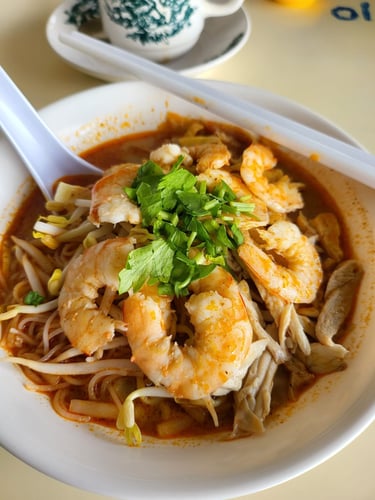
When visiting Kuching for the first time, you will probably hear about Sarawak laksa and kolo mee.
Both are closely associated with the city, and for good reason.
But Kuching's food culture goes beyond two bowls of noodles.
If you were introduced to the city through the foods people eat, you might discover unfamiliar vegetables, different noodle traditions and dishes connected to Sarawak's Indigenous communities.
Understanding these foods can tell you something about Kuching that a typical tourist itinerary may not.
Start with a Kuching Morning
One way to experience Kuching's everyday food culture is to visit a local kopitiam in the morning.
Coffee shops are part of daily life, where people stop for breakfast, meet friends or take a break before beginning their day.
Two dishes you will commonly encounter are Sarawak laksa and kolo mee.
Sarawak Laksa: More Than Another Bowl of Laksa
If you have eaten laksa in Singapore or Peninsular Malaysia, you may think you already know what to expect.
Sarawak laksa is different.
It is commonly served with rice vermicelli in an aromatic broth made using a distinctive spice paste, often with prawn stock and coconut milk.
Typical toppings include shredded chicken, prawns, bean sprouts and strips of egg, with sambal and lime served alongside.
The flavour is difficult to describe simply as curry or sour soup. Its character comes from the combination of spices, seafood and other ingredients in the broth.
For a first-time visitor, Sarawak laksa is an introduction to one of the city's most recognisable food traditions.
Kolo Mee: A Familiar Part of Everyday Life
Kolo mee may look less elaborate than Sarawak laksa.
It is usually a bowl of springy noodles tossed with seasoned oil and served with toppings.
Traditional Chinese-style versions commonly include minced pork and char siu, although chicken and beef variations are also available.
Unlike noodle soup, the flavour comes largely from how the noodles are prepared and tossed.
There are differences between stalls, including the seasoning and toppings. Some versions are light in colour, while others are reddish.
The reddish colour in some preparations comes from char siu marinade or cooking juices, which can also give the noodles a slightly sweeter flavour.
Kolo mee is worth understanding not because it is an extravagant dish, but because it is such a familiar part of Kuching's everyday eating culture.
What About Kuching's Other Noodles?
Visitors who stop at laksa and kolo mee may miss other local favourites.
Kuching-Style Tomato Noodles
Tomato noodles are one example.
A common version uses crispy or fried noodles covered with a tomato-based gravy, accompanied by vegetables and other ingredients such as meat or seafood.
The combination of crispy noodles and a savoury-sweet gravy may surprise visitors who associate tomato sauce mainly with Western pasta.
Different preparations exist, including versions made with flat rice noodles.
It is another example of how familiar ingredients can develop into a distinctly local dish.
Kueh Chap
Kueh chap is quite different from the noodle dishes above.
It typically consists of broad, flat rice noodle sheets served in a dark, aromatic broth.
Traditional pork-based versions may include pork belly, different cuts of meat, offal and eggs.
The broth and accompanying ingredients give the dish its character.
Visitors unfamiliar with pork offal should understand what is included before ordering, rather than assuming it is an ordinary bowl of rice noodles.
Kolo Mee and Kampua Mee Are Not the Same
You may also encounter kampua mee while exploring Sarawak food.
Although both are dry noodle dishes, kampua mee is particularly associated with Sibu and its Foochow Chinese community.
Kolo mee is more closely identified with Kuching.
Their noodles, seasonings and accompaniments can differ, although individual preparations vary.
Recognising this distinction helps visitors understand that Sarawak has several regional food traditions, not just one statewide style of noodles.
Do Not Overlook the Vegetables
One food that deserves attention is midin.
Midin is a wild fern commonly eaten in Sarawak. It is valued for its tender shoots and distinctive texture.
You may find it stir-fried with garlic or belacan, a fermented shrimp paste.
For visitors accustomed to vegetables such as kangkong, spinach or choy sum, midin introduces a different local ingredient.
It is also a reminder that Sarawak's food culture is shaped not only by its communities but also by the plants and ingredients available in the region.
Sometimes, understanding a place begins with something as simple as the vegetables served at dinner.
Foods That Reflect Sarawak's Indigenous Heritage
Kuching is also a place where visitors can encounter dishes associated with Sarawak's Indigenous communities.
These foods are not necessarily everyday breakfast items in a city kopitiam. Some are more commonly found in restaurants serving traditional Sarawak cuisine or prepared for family and community occasions.
They also have histories connected to other parts of Sarawak, rather than originating in Kuching itself.
Manok Pansoh: Chicken Cooked in Bamboo
Manok pansoh, also called ayam pansuh, is associated with Dayak cooking traditions, including the Iban community.
Chicken is prepared with ingredients such as lemongrass, ginger and other aromatics, then cooked inside bamboo.
The cooking method is an important part of the dish's identity.
For visitors, it offers an introduction to a food tradition quite different from the noodle dishes commonly associated with Kuching.
Umai: A Melanau Food Tradition
Umai is a traditional dish associated with the Melanau community of coastal Sarawak, particularly areas around Mukah and the central Sarawak coast.
It is not originally a Kuching dish, although visitors may encounter it in establishments serving wider Sarawak cuisine.
Umai is commonly prepared using thinly sliced fresh raw fish mixed with sour citrus juice, onions, chillies and other seasonings.
The acidity changes the texture of the fish, giving it a lightly cured character. However, the fish remains uncooked by heat.
Its preparation reflects the food traditions of Sarawak's coastal communities.
Because umai contains raw seafood, visitors should consider their dietary needs and choose food prepared with appropriate care.
Dishes such as manok pansoh and umai illustrate why Kuching's food culture cannot be understood through Chinese kopitiam dishes alone.
Something Sweet: Sarawak Layer Cake
Not every local food experience needs to be a full meal.
Sarawak layer cake, commonly known as kek lapis Sarawak, is recognised for its colourful, carefully arranged layers.
It is often associated with celebrations and festive occasions, although it is also sold throughout the year.
The different patterns and flavours make it visually distinctive.
For visitors, it is another opportunity to discover a food tradition connected to Sarawak's social and celebratory life.
A Few Things to Understand Before Ordering
Kuching's food culture is diverse, and dishes with similar names may be prepared differently.
A few practical considerations can help.
Check the ingredients. Some traditional Chinese noodle dishes contain pork or lard. Other versions use chicken or beef, but different toppings do not necessarily mean the cooking oil or broth is pork-free. Check halal certification where required.
Pay attention to when foods are served. Sarawak laksa and kolo mee are commonly associated with breakfast, although availability depends on the individual stall.
Do not expect every Sarawak dish to be uniquely Kuching. Foods such as kampua mee, manok pansoh and umai are connected to different places and communities across the state.
Ask about unfamiliar ingredients. A dish containing wild vegetables, fermented shrimp paste or offal may be unfamiliar, but understanding what is in it helps you decide whether you would like to try it.
Understanding Kuching Through Its Food
Sarawak laksa and kolo mee are natural starting points for someone visiting Kuching.
But there is much more to discover.
Tomato noodles and kueh chap show different sides of the city's Chinese food traditions. Midin introduces an ingredient closely associated with Sarawak's natural environment. Manok pansoh and umai connect visitors with Indigenous food cultures, while kek lapis reflects another part of local life.
Not every Kuching resident would choose the same dishes to introduce to a visitor.
That is part of what makes the city's food culture interesting.
The more you understand about the foods, their ingredients and the communities behind them, the more you begin to see Kuching beyond its familiar tourist attractions.
notitia.blog © 2026. All rights reserved.